


Key Takeaways:
- For Pearland parents, a sound estate plan starts with naming guardians and then connects that choice to who will manage money, make medical decisions, and handle finances if you cannot.
- A will, powers of attorney, and sometimes a revocable living trust protect different parts of your family’s future, so the safest plan is one built to work together rather than a stack of separate forms.
- Pearland estate planning is not a one-time task; documents, beneficiary designations, and trusted decision-makers should be reviewed after major life changes and kept current as your family grows.
Most parents in Pearland don’t lie awake worrying about legal documents. They worry about their kids: who would step in if something happened, whether the right people would be in charge, and whether their family would be okay.
Those concerns are exactly what estate planning is meant to answer. Yet many families either put it off or sign a generic will and consider it done. The problem is that a standard document doesn’t know your family, your assets, or the people you actually trust. Davidek Law Firm helps Pearland families build personalized plans that are clear enough to actually use and flexible enough to grow with your family.
What a Pearland Estate Planning Checklist Should Include for Parents With Minor Children
When parents think about estate planning, they often jump straight to questions about assets. But the most pressing question for any parent with minor children is simpler: if something happened to you tomorrow, who would take care of your kids? Naming a guardian is the foundation of any checklist for parents, and everything else builds from there.
Under the Texas Estates Code, you can designate both a primary and an alternate guardian for your minor children directly in your will or a separate written declaration. Courts give strong weight to that designation, so making it clear and legally sound matters far more than most parents realize. Without it, a judge decides, and that decision may not reflect what you would have chosen.
Beyond guardianship, a solid checklist addresses who manages money on your children’s behalf and who can make decisions if you’re alive but incapacitated. Those are two very different situations that call for different documents. Texas law also allows parents to name a custodian under the Uniform Transfers to Minors Act, which provides a structured way to manage inherited property until a child reaches age 21.
For some families, a trust offers more flexibility than a custodial account, especially when children are young, or assets are more complex. Davidek Law Firm’s guide for new parents walks through how guardianship, trusts, and life insurance fit together as a coordinated plan rather than separate pieces.
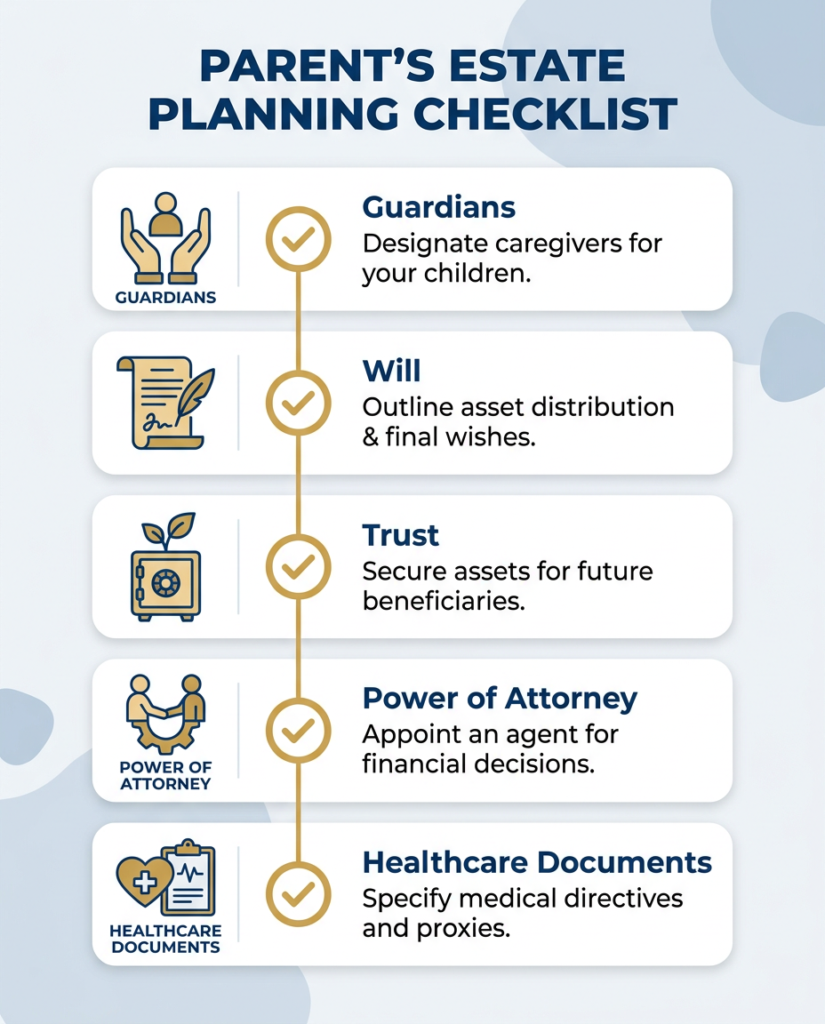
The most useful checklist isn’t a generic template. It reflects your children’s ages, what you own, and who you genuinely trust to step into each role. Here’s what that checklist should cover:
- Name a guardian and a backup. Designate both a primary and an alternate guardian in your will so the court has clear guidance if your first choice can’t serve.
- Decide who manages money for your children. This might be a trustee, a UTMA custodian, or both, depending on the size of the estate and the age of your children. These roles don’t have to be the same person as the guardian.
- Set up a durable power of attorney for finances. This gives someone the legal authority to manage your financial affairs if you become incapacitated. As explained in Davidek Law Firm’s overview of powers of attorney, a standard POA ends at death, so it works alongside your will rather than replacing it.
- Create a medical power of attorney and an advance directive. Someone needs the legal authority to make healthcare decisions for you if you can’t make them yourself. This is separate from your children’s guardianship and often overlooked.
- Review your beneficiary designations. Life insurance and retirement accounts pass outside of a will, so if a minor child is listed as a direct beneficiary, the court may need to get involved. Naming a trust or a custodian instead keeps that process cleaner.
- Keep the plan specific to your family. A checklist that doesn’t account for your children’s ages, the people in your life, or your actual assets leaves gaps that a generic document won’t catch.
No single document does all of these jobs. That’s why a Pearland estate plan works best when the pieces are designed to work together, which is exactly what the next section covers.
 How Wills, Trusts, and Powers of Attorney Work Together in Pearland Estate Planning
Many families ask how wills, trusts, and powers of attorney fit together in Pearland estate planning. The short answer: each one handles a different job, and when they work as a team, your family is far better protected than any single document can manage on its own.
A Will Handles What Happens After You’re Gone
A will directs how your assets pass at death and, for parents, names a guardian for minor children. Under Texas law, a properly executed will can also be made self-proving, which simplifies the probate process for your family. But a will cannot help if you are alive and simply unable to make decisions.
Powers of Attorney Step In During Life
This is where powers of attorney matter. A Texas statutory durable power of attorney lets a trusted person manage your finances if you become incapacitated. A medical power of attorney covers healthcare decisions. Together, they fill the gap a will leaves. Without them, a family may face a court proceeding just to manage basic finances.
A Trust Ties It All Together
A revocable living trust can hold and manage assets both during your lifetime and after your death, which means fewer disruptions if something happens to you. As Davidek Law Firm’s Texas estate planning FAQs explain, a personalized plan works because the people named in each document, the assets covered, and your family’s wishes all point in the same direction. Gaps appear when documents are created separately and never checked against each other.
When a Revocable Living Trust Makes More Sense Than a Will for Pearland Families
A will is a solid starting point, but it only speaks at death. For Pearland families who want a plan that also works if a parent becomes incapacitated, a revocable living trust can fill that gap in a way a will simply cannot. The comparison below lays out where each option fits and where each falls short.
| Factor | Will | Revocable Living Trust
|
|---|---|---|
| When it takes effect | At death only | Immediately upon signing and funding |
| Incapacity planning | Does not apply; a separate power of attorney is needed | Successor trustee steps in under Texas Trust Code Sec. 113.081 without court involvement |
| Probate requirement | Yes; assets must pass through Texas probate court before reaching beneficiaries | No probate for assets held in the trust |
| Privacy | Becomes a public record through probate | Remains private |
| Asset management for minor children | Directs who receives assets; a separate testamentary trust or guardianship may be required | Trust terms control timing, conditions, and distribution directly |
| Complexity and cost to create | Lower upfront | Higher upfront; requires funding assets into the trust to function |
| Best fit | Simpler estates; naming guardians; assets with clear beneficiary designations | Families with younger children, a home, or a preference for continuity and organized management |
A trust is not a universal upgrade, and that point matters. As Davidek Law Firm’s top Texas estate planning questions page notes, an unfunded trust is essentially an empty shell. The legal structure exists, but assets that were never transferred into it will still go through probate.
Families with younger children, a family home, or more layered finances tend to benefit most from pairing a properly funded trust with a pour-over will, powers of attorney, and a healthcare directive, as outlined in the Texas State Law Library’s guide on wills and directives. The right choice comes down to your family’s specific circumstances, not which option sounds more thorough on paper.
Common Pearland Estate Planning Questions About Updates and Family Changes
Life rarely holds still, and neither should your estate plan. The questions below address the moments families most often overlook: what triggers a review, whether a will alone is enough, and what to do when the people you trusted are no longer the right fit.
How often should Pearland families update their estate planning documents after major life changes?
At a minimum, plan to review your documents every three years and immediately after major life events. Marriage, divorce, a new child, a move, or a significant change in assets each deserves a fresh look. Waiting too long can leave outdated instructions in place that no longer reflect your family’s reality.
Does a will alone fully protect minor children?
A will is a starting point, but it does not cover everything. It cannot manage your children’s finances in the event of your incapacity, and it does not control assets such as retirement accounts or life insurance that pass through beneficiary designations. Powers of attorney and, in some cases, a trust fill those gaps in ways a will simply cannot.
What happens if a named guardian or agent is no longer the right fit?
You can update those designations at any time while you are still able to do so. Under Texas law, guardianship arrangements can also be modified through the courts when circumstances change. Reviewing your named roles regularly means your family is never left relying on someone you would not choose today.
Do beneficiary designations need to be updated separately from a will?
Yes, and this catches many families off guard. Beneficiary designations on retirement accounts and life insurance operate independently of your will. After a divorce, for example, federal ERISA rules may still direct funds to a former spouse if the designation was never changed. A complete review means checking both.
Is there a way to keep an estate plan current without having to start over every few years?
Davidek Law Firm’s Family Care Program is built for exactly this. It combines an annual review with on-demand updates so that changes to your family or finances are addressed as they happen. That kind of ongoing attention is what keeps a plan working rather than just sitting in a folder.
Build a Pearland Estate Plan You Can Understand and Keep Current
The best estate plan is not the most complex one. It is the one your family actually understands, knows where to find, and can put to use when it matters. Texas law sets specific requirements for documents such as durable powers of attorney and guardian designations, and those requirements can change over time. Keeping documents current, including advance directives, protects your family from gaps that standard, one-time paperwork often leaves behind.
A plan filed away and forgotten doesn’t protect anyone. Pearland estate planning works when it is built around your specific family. The right people are named in every document, the terms are clear enough for your family to use, and a process is in place to keep everything up to date as life changes.
At Davidek Law Firm, plans are built around your family’s actual circumstances, not a generic template, and the Family Care Program ensures your documents stay accurate as your family grows and changes. Visit Davidek Law Firm to start building a plan your family can count on.
